


I once slept in my truck with a pet rat named Merlin because I was homeless and had nowhere else to go. A couple of weeks ago, a senior executive called me to talk about the parts of their story they rarely speak about.
I have been thinking about the distance between those two moments ever since.
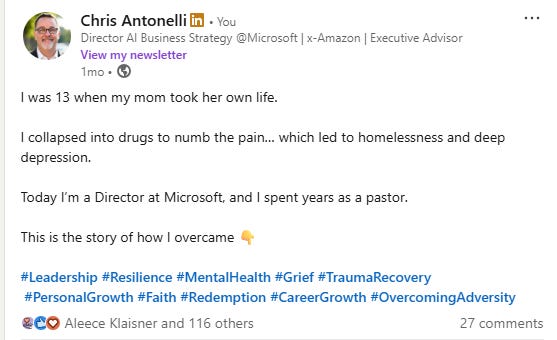
When I published my recent essay about that season of my life, the addiction, the homelessness, the truck, I also decided to share most of it on LinkedIn. Not the polished watered down version, but the real one, including the drug addiction, the homelessness, and how in the middle of all of it I came to accept Jesus.
That is not normal content for LinkedIn, where people post promotions and thought leadership and carefully curated professional milestones. It is not typically where someone admits they once had nothing, real problems, nowhere to go, and only a rat for company.
But I posted it anyway and then honestly held my breath and waited.
The response was unlike anything I expected. Messages came in from people I had not heard from in years, comments from strangers, readers here reaching out privately, all of them saying the same thing in different words: I needed to read this today. I thought I was the only one.
But the moment that stopped me completely came a few days later when a senior leader called me. Not a comment, a like, or an instant message. A phone call.
They told me the piece had impacted them deeply, that it had reminded them of parts of their own story, parts they had not talked about in a long time, parts that lived underneath the title and the responsibility and the carefully maintained exterior that senior leadership requires.
I did not know what to say. I still don’t have fully adequate words for it.
What follows is what that phone call reminded me about the leaders at the top of every room you will ever walk into, and why you need to hear it.
What Titles Actually Do to People
I have spent decades in rooms with executives and senior leaders, watching people manage up, manage across, and manage perception. I have seen the performance that happens around power: the careful language, the guarded posture, the way people become overly agreeable or quietly intimidated in the presence of authority. And after all of it, one thing remains consistently true. People are still people.
The title changes the room. It does not change the human being sitting inside it.
Harvard Business Review reports that more than half of CEOs experience loneliness in their role, and two-thirds of senior executives never receive coaching or outside perspective at all. The most powerful people in the room are often the loneliest and most isolated people in the room. They just learned not to show it.
Behind the authority is still someone carrying private pressures, quiet insecurities, family weight, disappointments, and fears that very few people ever see. The higher someone rises, the fewer honest conversations they tend to have. People become careful around them, the warmth gets replaced by politics, and the humanity gets replaced by posture.
The senior leader who called me did not need my encouragement that day. I needed theirs. But what happened in that conversation was something neither of us planned. Two people, different titles, different seasons, recognizing something true in each other’s story. We all come into this world the same way. We all leave it the same way. Everything in between is just the life we carry and it is better with others.
The Word That Cuts Through
This is why a timely word can land with such unusual force in the most powerful rooms. Not flattery or calculated encouragement designed to advance your position, just a real honest word that sees the person instead of the title.
Solomon understood this long before any of us sat in a boardroom. “A man finds joy in giving an apt reply, and how good is a timely word.” Proverbs 15:23.
We are all carrying more than we show, and we are all waiting, more than we admit, for someone to see us clearly and speak to what they see. A timely word cuts through the distance and reminds people they are not as alone, and it opens doors that no amount of strategy or positioning ever could.
Never assume the person at the top of the room needs it least. They often need it most. They just stopped asking for it a long time ago.
Before you get to this week’s plan, think of one person. A leader you know, someone carrying more than they show, someone who probably hasn’t heard an honest word in a while. This essay exists for them as much as it exists for you. Forward it. That might be the timely word they have been waiting for.
The 7-Day Baseline: See the Person Again
Once per day this week. One minute. That’s all.
Day 1: Look past the title
Who am I seeing primarily through their role instead of their humanity? Identify one person you tend to view through their position or authority and make a conscious decision to see the person again today. “The LORD does not look at the things people look at. People look at the outward appearance, but the LORD looks at the heart.” 1 Samuel 16:7
Day 2: Notice the distance
Where have titles or authority made me more guarded than human? Pay attention to one room today where you become overly careful or performative and notice what the title is doing to your posture. “A word fitly spoken is like apples of gold in settings of silver.” Proverbs 25:11
Day 3: Offer real encouragement
Who around me may need a timely word more than I realize? Encourage one person specifically today, not flattery, but something thoughtful, sincere, and true. “Pleasant words are a honeycomb, sweet to the soul and healing to the bones.” Proverbs 16:24
Day 4: Speak with warmth
Am I speaking around power, or am I speaking to the person? In one conversation today, lower the performance and increase the humanity. Be direct, kind, and fully present. “Let your speech always be with grace.” Colossians 4:6
Day 5: Listen beneath the surface
What might someone be carrying that I cannot see? Slow down enough to listen past the title or exterior and assume there is more weight there than is visible. “Know well the condition of your flocks, and pay attention to your herds.” Proverbs 27:23
Day 6: Build someone up
Where can I use my words to strengthen instead of simply observe? Do not keep the good thought to yourself. If you see something worth affirming, say it. If you sense someone is carrying weight, acknowledge it. “Therefore encourage one another and build up one another.” 1 Thessalonians 5:11
Day 7: Carry it forward
What would it look like to consistently see the person behind the position? Choose one relationship or room you want to approach differently going forward and commit to bringing more warmth and timely words into that space. “So then we pursue the things which make for peace and the building up of one another.” Romans 14:19
If this resonated and you are carrying something heavier than a weekly essay can address, I have a Momentum coaching slot open this month. You do not have to sort it out alone. Work With Me
Here is my story I referenced above:
Why I Don’t Trust “I'm Fine”

Some losses in life deeply mark you, and then they shape the rest of your life.
Was talking to a business leader today about systems and complexity.
My advice: Build relationships and focus on direction. All the other stuff will mostly take care of itself.