


Author’s note: This is Chapter One of my new novel, Watching from the Hill. It is a frontier story set in California’s gold country, about a quiet homesteader who gets drafted into leading his town after turmoil unfolds. I am writing it in public here on Substack so you can follow the story as it unfolds.
New chapters will publish roughly once a month as the story continues. If you want to follow Mason’s journey in real time, make sure you are subscribed.
Chapter One: The Knock at Dawn
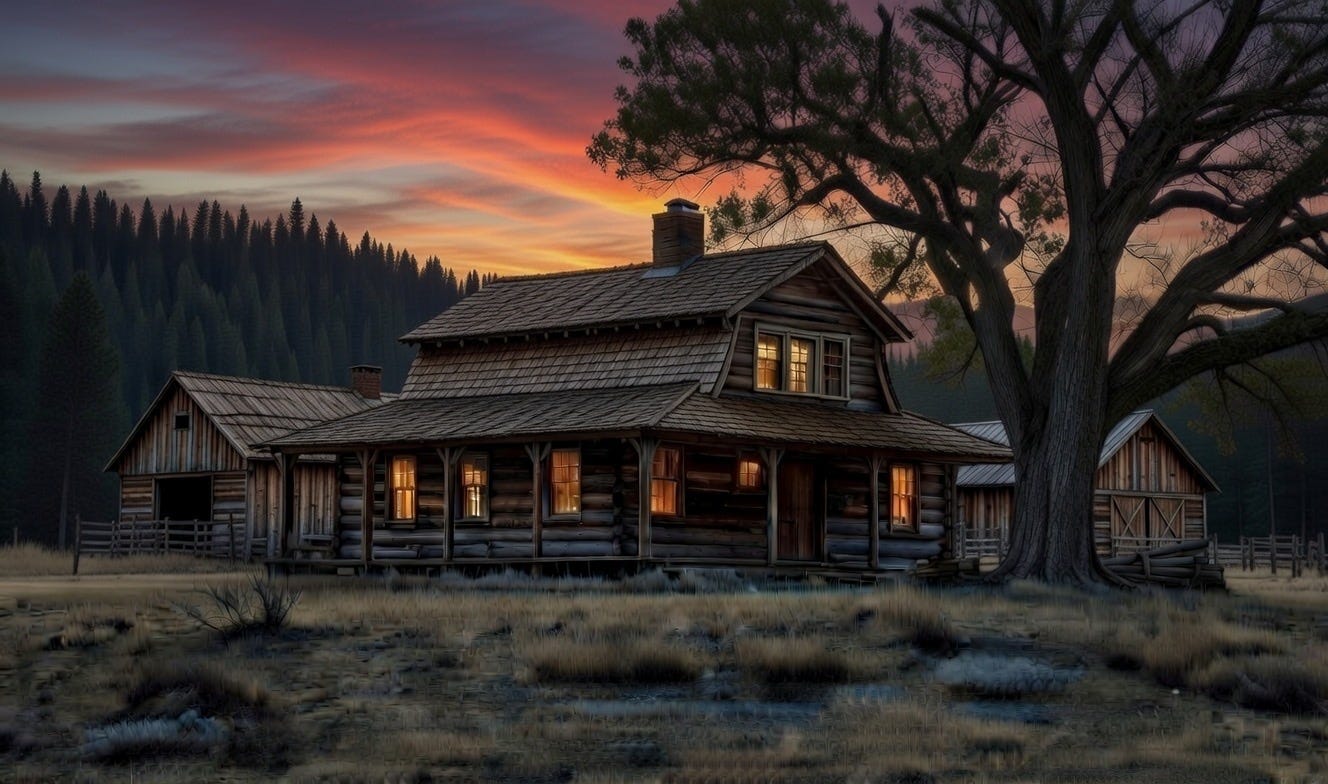
That morning I awoke earlier than normal. There was a chill in the house that told me autumn was drawing to a close and winter was rapidly approaching. I could hear the wind outside, dashing through the nearby oak tree, and inside as it pushed through the wood beams of our small cabin. Our place sat on a low hill above Cedar Hollow, a worn-out gold town in the Sierra Nevada foothills that the maps still showed more out of habit than respect. Looking back, nothing in that quiet morning hinted that it would be the last truly simple day for a long time.
Although momentarily tempted to stay nestled under our warm blankets, I knew the morning routine would not wait, so I slipped out of bed as quietly as possible over the creaking wood floors, put on my overalls and boots, and began building a fire in the wood stove to warm our home.
After lighting the fire, I filled the kettle and placed it on the wood burning stove and, as part of what had become a daily ritual, I sat there in the mostly dark homestead, next to the crackling fire, slowly cranking the handle over and over again to get the perfect ground coffee. An old ranch hand once told me that strong coffee and honest prayer could carry a man through almost anything, and I had come to believe him. After the War I had seen enough noise, smoke, and chaos to last a lifetime, so this quiet work of tending land and family was something I had chosen on purpose.
Once done with the grounds, I placed them on my canteen with a small homemade filter on the top, and then, ever so slowly, I poured the hot water over the grounds, waited for it to filter through into the canteen, and then I poured a bit more. I repeated the motion again and again, just savoring the quiet, the aroma, and the hope of a new day ahead.
I removed the filter and grounds and poured myself a cup of coffee that I had become a bit famous for among my neighboring homesteaders. Their coffee had grounds in the bottom of the cups and tasted like shoe polish; mine had no grounds, was very strong, but also smooth without the bitterness. That canteen would last me all day as I tended to the animals and crops, but I always made sure I had enough to share.
As I sat there sipping my cup, I said a quick morning prayer. “Thank you, Jesus, for your love, this day, my beautiful wife and family, and the day ahead... Also, Lord, I want you to know how deeply grateful I am for this good cup of coffee.”
I had barely taken my second sip when the quiet broke. At first it was faint, just a low rumble beneath the wind, but then I heard the uneven crunch of wagon wheels on the packed dirt and the soft snort of horses... far earlier than any visitor had a right to be there. We lived too far out for casual drop-ins, and folks who knew us also knew our mornings were for chores, not company. The wagon creaked to a stop, the wind filled the silence again, and a moment later there was a firm knock at the front door that told me whatever waited on the other side was not bringing good news.
I stood at the same moment the knock sounded and headed toward the door, my eyes already on the belt hanging by its peg. My hand was just starting to reach for the revolver when I heard a familiar voice through the wood.
“Mason, it is Reverend Mudd.”
I let my hand fall away from the gun and started to open the door. From the bedroom my wife, Elle, called out, her voice edged with concern, “Everything okay, Mason?”
“It will be fine,” I assured her, though I was not yet certain, and then I pulled the door open to find my old friend Reverend William Mudd on the step. We had served together in the War, and he had come to Cedar Hollow to pastor not long after we settled on the hill. He was a massive man, broad shouldered and thick, looking more like Goliath than a preacher.
“Sergeant, sorry to trouble you so early, but we have a problem,” he said.
“It is Mason now, Reverend, you know that,” I replied. “Come in and tell me what is the matter.”
Reverend Mudd stepped inside, the chill following him for a moment before the fire pushed it back. We moved to the chairs by the stove and I poured him a cup of coffee without even asking. I already knew how he loved it. He wrapped his big hands around the tin cup, stared into it for a moment, then began.
“Mason, I am sorry to be the one to tell you this, but Bill Rudd was gunned down earlier tonight. I know you two were close.”
As he spoke, my heart sank for more than one reason. First because Bill was a dear friend with a young family. Second because I knew the weight of leadership he carried for our little town. Cedar Hollow had once been a wild gold camp and Bill had helped usher it from those days of chaos into what it was now. A growing town of families trying to build their futures. He was not only the sheriff; he served as mayor and was, in truth, the backbone of the town.
I had led him once, when we served together, and in the years since I had been his confidant and advisor as he steered Cedar Hollow toward something better. I was content to lead from behind. It had been a welcome change.
“Mason, did you hear me?” Reverend Mudd asked.
I realized I had been staring into the fire. I nodded slowly as I came back from the first shock and he went on.
“You see, Mason, the town council met in an emergency session. They voted unanimously to appoint you interim sheriff and mayor. Even Wally agreed.”
That last name pulled my eyes up. Wally was the closest thing I had to a nemesis in Cedar Hollow. He was an old, grouchy farmer who liked to be right all the time... and liked it even better when I was wrong.
“That is not going to happen, Reverend,” I said. “There are plenty of other options on the table here. Let us figure something else out.”
Even as the words left my mouth, I knew they were not really true, no matter how much I wanted them to be.
“Mason, I know you came here for a simpler life and to build your family’s legacy,” he said quietly, “but sometimes God’s plans for us are more fluid than we would like.”
“Mason, what is wrong?”
Elle had come from the bedroom, wrapped in her nightgown, her long brunette curls falling over her shoulders. She looked from me to Reverend Mudd, eyes already shining with worry.
“Billy is dead,” I said.
As the words left my lips I clenched my fist, trying to hold back the tears that rose with the memories that flooded my mind in a flash... us fishing together at the creek, him standing beside me at my wedding, the two of us sitting for hours over coffee talking about life, God, family, country, and our little bustling town. The other reason for the clenched fist was a quiet, righteous anger toward the ones who had taken Bill from Cedar Hollow when we most needed him.
“Hon, they need you,” Elle said softly, tears now running down her cheeks. She glanced toward the wood stacked near the stove. “It is like these logs here by the fire. They have a purpose. When their time comes, they do the job they were created for.”
I loved my bride. I wished she were wrong. But she also knew that for months I had been journaling about purpose, asking God to use me in whatever way He saw fit. I had just hoped it would be in making more coffee and raising crops, not wearing a badge as sheriff and mayor.
“Okay, Reverend,” I said at last. “I will consider it. I will meet you back in town for breakfast and we can talk to the council. Let them know there will have to be some things agreed upon up front.”
He finished his coffee, rose to his feet, and placed a heavy hand on my shoulder. We said our goodbyes and I walked him to the door, watching as he climbed back onto the wagon and turned the team toward Cedar Hollow.
Elle and I sat down again next to the fire, saying nothing for a long while. Tears ran down my face as the flames snapped and shifted. Somewhere beneath the grief I felt a strange calm begin to settle over me, and my mind, almost by habit, started to work. I found myself thinking and quietly strategizing how we might push back the chaos that had slipped into our town while we slept.
“We should wake the girls,” Elle said at last. “They need to hear this from you.”
She was right. Our daughters were not little any longer. Sierra was sixteen and already as tall as her mother, with the same steady eyes. Natalie was twelve, quick minded, always asking questions, always watching more than she let on. If this storm was about to roll through our family, they had a right to see the clouds coming.
We walked down the short hallway together. I pushed open the door to their small room and saw them curled under their quilts, the soft rise and fall of their breathing a brief reminder that, for them at least, the world was still simple.
“Sierra, Nat,” I said quietly. “Girls, time to wake up.”
Sierra stirred first, rubbing her eyes, then pushing herself up on one elbow. “Pa? It’s still dark.”
Natalie blinked at me from the other bed. “Is something wrong?”
I sat on the edge of Sierra’s bed while Elle went to sit beside Natalie. “You both remember Sheriff Rudd,” I began.
“Of course,” Natalie said. “He brought us that taffy from Placerville.”
“And he helped you fix the gate when it broke last winter,” Sierra added.
I nodded. My throat tightened for a moment before I could speak. “Bill was killed last night. Raiders caught him on the road outside town.”
Natalie’s hand flew to her mouth. Sierra just stared at me, eyes wide and glassy.
“I am telling you because this is going to change things for Cedar Hollow,” I said. “And it may change things for us too. The council has asked me to step in for a time... to help lead, to keep folks safe until we know what we are dealing with.”
“Like when you led your men in the War?” Sierra asked quietly.
“In some ways,” I said. “In some ways I hope not.”
Elle reached for Natalie’s hand and squeezed it. “They are asking your father to help carry the load Bill was carrying,” she said. “It is not what we planned. But sometimes calling comes looking for you instead of the other way around.”
“Is it dangerous?” Natalie asked.
“Yes,” I answered. There was no sense pretending otherwise. “It always is, when you stand between people and the trouble that wants to swallow them. But it would be more dangerous, in the long run, if good men kept saying no.”
We prayed together right there between the two beds, our hands linked, my words simple. I asked God to comfort Bill’s family, to guard Cedar Hollow, and to give us courage to do what was right… even if it cost something. When we finished, the girls were quiet, but their faces were set in that stubborn way that reminded me of both their mother and of myself.
“We will help Ma with the chores,” Sierra said. “You go do what you need to.”
I nodded and kissed each of them on the forehead. “I will be back this afternoon if I can,” I said. “If not, you listen to your Ma and stay close.”
The sky was just beginning to turn pale when I stepped out to the small lean-to that served as our tack room. The air bit at my face as I saddled up my bay gelding, Jasper, tightening the cinch with practiced hands. The motions were old and familiar, the kind that let your mind wander while your body worked.
I checked my gear carefully. Rifle in its scabbard, oiled and ready. Two pistols, one on my belt and one in the saddlebag. A small coil of rope, a knife, a pencil stub and folded notebook. And of course my canteen of coffee, clipped to the saddle where I could reach it easy. If I was going to ride into council chambers and trouble in the same morning, I fully intended to do it awake.
By the time I led Jasper around to the front, Elle and the girls were standing on the small porch. Sierra’s arm was around Natalie’s shoulders. Elle’s eyes were red, but her chin was lifted.
“Remember your conditions,” she said. “You are not going in there to be pushed around, Mason.”
“I remember,” I said. “If I take this on, it will not be alone and it will not be without a plan.”
As I put my boot in the stirrup, a memory slid into my mind, as clear as if I were back in a muddy field two decades earlier. Captain Harris, standing in the half light of dawn, coat unbuttoned, hat in his hand, looking us over before we marched into another mess that some officer in a warm tent had sent our way.
“Chaos loves eating time, boys,” he had said, voice low but firm. “Organize or get eaten. You do not have to like what is in front of you, but you had better meet it with a plan.”
At the time I had just been tired and cold and wanting to go home. I had not understood how often life would circle back to that same fork in the road.
I swung up into the saddle and settled myself, the leather creaking beneath me. Looking down at my family, I felt the old familiar knot of fear and duty twist together in my chest. This was not a battlefield, but the choice smelled the same. I could pretend someone else would handle it, or I could ride into town and help put some shape around the chaos before it swallowed Cedar Hollow whole.
“I will be careful,” I said. “And I will be home as soon as I can.”
Elle nodded. “We will be here,” she replied. “And we will be praying.”
I touched the brim of my hat to them, then turned Jasper down the rutted road that led off the hill and toward town. The hooves thudded a steady rhythm in the packed dirt as we descended, the cool air carrying the faint scent of smoke from the distant chimney fires beginning to wake.
My list rattled around in my mind as we rode. Talk to the council about patrols and watches. Demand clear terms on authority and limits. See Bill’s family. Figure out what we knew about the raiders and, more importantly, what we did not. Make sure Wally understood that arguing over every fence line and penny would have to wait.
Beneath all that, like a low drumbeat, was something else. Not excitement exactly, but a kind of sober anticipation. I had wanted purpose. I had asked God for it in the quiet hours with my journal and my coffee and the fire. Now purpose had ridden up my drive in a wagon at first light and knocked on my front door.
As Jasper and I rounded the last bend and the roofs and streets of Cedar Hollow came into view below, the eastern sky was lifting from gray to pale gold. I tightened my grip on the reins, took one more pull from the canteen, and let Captain Harris’s old words settle in my mind like a promise.
Organize or get eaten.
I did not know yet what this day would require of me or what it would cost, but I knew one thing for certain as we rode down toward the waking town.
I was finished watching from the hill.
Coming soon: Watching from the Hill, Chapter Two: Council in Crisis
Make sure you’re subscribed so you do not miss the next chapter from Cedar Hollow.
If you want early access to future chapters and some behind-the-scenes notes on the writing and leadership themes in this story, consider becoming a paid subscriber. I will be building Cedar Hollow in public and would love to have you along for the ride.
Sounds like Mason makes a great cup of coffee!
Thanks for sharing this. This is inspiring me to get my rough draft a little cleaner so I can share it.
I'm sure it was hard, but it absolutely paid off! The chapter is fantastic. Excited to keep reading! And can't wait for chapter 2
And on separate note... If you'd ever appreciate more detailed reader feedback as the story continues, I'd happy to give you a DM to learn more on specific areas you had like me to focus on...