


Something Stupid Is Happening.
People are freaking out after reading an article recently posted on X titled “Something Big Is Happening”. It has over 82 MILLION views and 6K comments. You should read the article, it’s important because it highlights some challenges of the evolution of AI and it is thought provoking for things we should all consider.
But it’s far from the only one. Mainstream outlets pile on daily with hopeless takes, like Fortune’s recent piece warning an “AI doomsday where many workers are ‘essentially unemployable’ is totally possible.” No wonder friends, family, and mentees are reaching out, asking if things are about to go sideways fast.
The fear-mongering is fueling unnecessary panic... and that’s exactly why I’m calling my response “Something Stupid Is Happening.” This fear-infused narrative is stopping people from doing the one thing that matters most right now: learning and adapting.
Don’t get me wrong... real challenges lie ahead as AI advances. But many stem from self-inflicted anxiety (humanizing AI too much) and gaps in governance, not inherent flaws in the technology itself.
Being optimistic and calm amid change is one of the greatest acts of leadership you can demonstrate. With 30 years in tech and my current role as a Director at Microsoft in AI Business Solutions, I’ve seen waves of disruption come and go. I firmly believe contagious optimism (paired with action that drive results) makes leaders truly future-proof.
Below I will show you why and how we can do this.

The Viral AI Panic: What’s Really Behind the Headlines?
Let’s get real. I actually work to enable AI Globally at massive scale, have been in tech for 30+ years, and I know the people that “know things” throughout the industry... most people with strong opinions in the news media and online do not.
There are a things I love about social media... but let’s just say that comes with some... “challenges”. I encourage people I advise to “curate” who they listen to in most areas... but especially emerging areas like AI.
The article by Matt was insightful and in many ways brilliant, BUT I think there is so much sensationalism going around about AI that his article gets twisted into fear instead of wisdom and intrigue. If you haven’t read his article, here is a super brief synopsis:
Matt’s essay compares the current AI surge to early COVID warnings, claiming recent 2026 models (like GPT-5.3 Codex) have crossed a threshold: they now build and refine complex apps autonomously, show judgment-like decisions, and even help improve themselves in a fast-accelerating loop. He predicts swift disruption to many white-collar jobs (coding, law, finance, etc.) within 1–2 years and urges people to start using top paid AI tools seriously now to adapt and get ahead... framing it as an opportunity, not just alarm.
Scary, huh?!
You have to realize that much of the reposts, comments, and media coverage are meant to make your fearful for one main reason... to farm your clicks and attention. X’s algorithms as an example thrive on emotions and prioritize emotion-rich content that sparks responses, outrage, or anxiety... over balanced takes. I am certain this article I am writing in comparison that is primarily optimistic... will not go viral.
We’ve seen this playbook before with overhyped tech panics like the Y2K bug (yep... I was there too), which promised global catastrophe but fizzled into minor glitches after trillions in preparations, or the early 1990s internet doomsday predictions of societal collapse that instead birthed unprecedented connectivity and prosperity.
Over 80 million views sound massive, but they are masked by the reality... a huge chunk comes from bots inflating impressions, automated reposts farming engagement, and users skimming headlines without reading the full piece... meaning far fewer than 82 million people truly engaged or understood the nuance... nor did they read the punchline.
If you actually read the whole article you will see near the bottom one of the most important paragraphs in the entire piece...💡
“I’m not writing this to make you feel helpless. I’m writing this because I think the single biggest advantage you can have right now is simply being early. Early to understand it. Early to use it. Early to adapt.”
Yes, major breakthroughs have happened with some of the latest AI models and YES they are game changers long term for the trajectory of AI... but as someone who works to enable customers globally to implement and utilize AI at scale... we need to dial back a bit of the fairytale and understand we are at the start of this journey... not at the end of it.
On-Prem - Cloud Industrial Revolution
The reality is AI is bringing amazing value to customers who implement it by making their employees more productive to cut down on administrative burden and think through automation in new ways, but they are also a lot of complexities just like there were with the last industrial revolutions of PC emergence and On-Prem to Cloud emergence.
Remember those? I do!
You’re not too late to learn and utilize these technologies. Are you willing to learn and dream, or will you get left behind?
Do you remember the progression of ON-PREM to CLOUD revolution? I was actually there when it started working for Seagate Technology as a Senior Tech Support Engineer helping Customers with their backup tape drives.
Then cloud computing came along and people started freaking out that On-Prem was doomed to fail fast... well, more than 25 years later, it’s still evolving and even after trillions in transformation... on-prem is still alive.
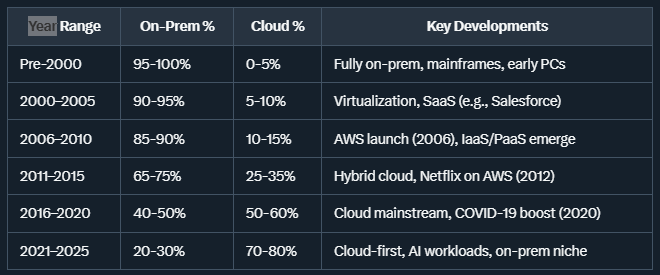
The AI Industrial Revolution is likely going to dwarf On-Prem - Cloud in both scale and speed of emergence, but make no mistake that there is still a lot of work to be done and complexities will not automagically be resolved without humans actually building, utilizing, implementing, servicing, and more.
AI will not replace leaders...
Well, I’m going to be direct with you.
I don’t believe AI will replace leaders. But leaders who learn to work with AI will likely replace those who do not.
I am not a proponent of FOMO (fear of missing out) in most areas of life. Fear-based decision-making usually leads to shallow thinking, bad habits, and unnecessary anxiety.
But there are rare moments when refusing to engage becomes self-sabotage. Artificial intelligence is one of those moments. This is not about speed. It is about moving in the right direction. If you begin now, even imperfectly, you will build confidence, competence, and discernment over time. That combination is what future-proof leadership actually looks like.
AI fluency is not about chasing the future. It is about leading responsibly in the present by having a learn it all mentality.
Why This Matters
For leaders and emerging leaders across every industry, learning how to work with AI is no longer optional. It is not a trend or a tech hobby. It is a foundational skill that will define who remains relevant, trusted, and influential over the next decade. This is about becoming future-proof.
I have spent more than 30 years in technology, long enough to see multiple waves of innovation come and go. I worked in cloud computing before most people understood what the cloud actually was, and I watched it move from skepticism to infrastructure to table stakes over the course of two decades. The leaders who leaned in early were not just more employable, they helped shape how the technology evolved and how it is used today.
Today, I serve as a Director of Business Strategy at Microsoft in the AI Business Solutions division, where I enable our frontline customer success teams to help customers around the world implement and maximize their use of AI, Chat, and Agents.
I am not watching this from the sidelines. I am in the middle of it, and its emergence is fascinating and exciting.
Here is the reality that leaders need to understand.
Every major research firm agrees that AI adoption will accelerate dramatically over the next five years. Productivity gains will not be evenly distributed. Roles will not disappear overnight, but expectations will shift quickly.
Those who understand how to work with AI will outperform those who do not, even when they hold the same title, education, or experience. That gap will compound.
If you learn AI now, you will be ahead of the vast majority of the workforce. Not because you are more technical or even smarter, but because you are FLUENT.
Fluency creates confidence. Confidence creates influence. Influence creates opportunity.
Becoming Fluent: Utilizing Microsoft Copilot Example
I recently organized and led a massive global enablement initiative with hundreds of people to help our teams prepare for the second half of our fiscal year. This consisted of 25+ one-hour Microsoft Teams meetings that I facilitated with each area leader, key leaders from their region, and corporate senior leaders.
The goal was to come away with key themes and precise actions of what is working and what is challenging at the area level, the region level, and globally so we can best support our customers.
I set up Researcher and Analyst in Microsoft 365 Copilot ahead of time, and because I knew we would record each of these meetings, I told researcher that I wanted themes in those three categories as well as a consolidated action tracker.
Prior to AI, this would have been a massive undertaking with multiple note takers, consolidation of themes, and then a multi-stage analysis across the three buckets.
That likely would have taken two weeks to deliver and let’s be honest the value proposition of program managers sitting in meetings simply to take notes is not high value.
Instead, this was about four hours of work with an immediate deliverable. It was de-duplicated, nearly immediately implementable, and each task had a named action owner pulled straight from the transcript.
That is just a small example of the power of harnessing AI in the midst of HUMAN work and learning as you go.
I had extensively utilized AI for other tasks ranging from creative, administrative, research, and communications... but I had never utilized researcher at this level to bring over 25 bifurcated meetings together into a single output... it was remarkable.
Don’t Surrender YOUR Influence
There is also a deeper reason learning and growing your influence in AI matters, especially for faith-oriented or values-driven leaders who want to ensure their perspectives are considered as AI starts to further permeate into society.
If thoughtful, ethical, faith-grounded people avoid AI because it feels uncomfortable or unfamiliar, then AI will be shaped without those voices.
Technology does not form itself. It reflects the inputs, assumptions, and values of the people who build and use it. Opting out does not preserve virtue. It surrenders influence.
The framework I developed below is how to do that without overthinking it and just get started on the journey. You do not need to become technical. You need to become fluent.
The AI Fluency Framework for Leaders
You do not need to become an engineer or understand how models are built to lead well in an AI-driven world. What you need is practical fluency, built through consistent, real-world use. Knowledge will build quickly if you implement repetitive learning.
This framework is designed for busy leaders who want to learn AI the same way they learn anything… by using it, refining it, and applying it to real decisions that matter.
1) Replace Search With Conversation
What you do
Install the M365 CoPilot (or ChatGPT) app on your phone.
Use it instead of Google Search once per day.
Ask at least one follow-up question every time for more granularity.
When you want credibility, ask for sources and click one.
Why it works You build comfort quickly and learn how to refine questions through conversation, not keywords.
Use this prompt “Explain this simply. Then give me the adult version in five bullets. Include source links.”
2) Turn AI Into a Planner
What you do
Plan a date, trip, weekend, or work offsite using AI.
Give constraints like budget, time, location, and preferences.
Ask for five options, narrow them down, then choose one.
Ask it to turn the final plan into a clean itinerary.
Ask it to produce a printable version.
Then ask it to turn the itinerary portion into an image for your phone.
Why it works You learn collaboration, not just question and answer. This is where AI starts saving real time.
Use this prompt “Give me five options based on these constraints. Ask me three questions to narrow it down. Then create an itinerary.”
3) Use AI to Understand Complex Things
What you do
Upload a long document, medical result, or dense material. NOTE: Not internal company documents of course
Ask for a summary first.
Ask for risks, decisions, and next steps.
Set parameters like “keep it concise” or “explain it like I am 10.”
Why it works AI reduces overwhelm and helps you see what actually matters without drowning in detail.
Use this prompt “Summarize this in plain English. Tell me what matters most. Give me next steps. Keep it concise.”
The 14-Day AI Fluency Challenge
Fluency is built through repetition, not theory. This simple two-week challenge is designed to move AI from something you read about into something you confidently use. If you follow this progression, even imperfectly, you will develop intuition, comfort, and momentum faster than most people in your organization.
Days 1–5: Build the habit
Replace Google Search with M365 Copilot (or ChatGPT) once per day.
Days 6–10: Learn collaboration
Use AI to plan one real thing and have it produce a usable itinerary.
Days 11–14: Build clarity under complexity
Upload one complex item and ask for summary, risks, and next steps.
Principles to Remember
A few principles I repeat often when coaching leaders through this shift:
Do not treat AI like an autonomous human. Use it like a hive mind alongside you. Agents can help with automation, but that is a deeper learning tract.
Do not outsource your thinking. Use AI to sharpen judgment, not replace it.
Do not fear basic questions. Curiosity is a leadership strength, not a weakness.
Do not wait for permission to learn. Leaders move first, then bring others with them.
Do experiment and you can also give AI multiple commands at once, even a few bullet points
Final Thoughts
Last but not least, do not let your heart be troubled. There is so much fear and hopelessness in the world, and we have learned that rapid changes like the rise of AI can stir deep anxiety.
Yet as followers of Christ, our hope is anchored not in technology’s promises, but in the unchanging truth: “Do not let your hearts be troubled. You believe in God; believe also in me” (John 14:1).
Jesus spoke these words to prepare His disciples for uncertainty, reminding them (and us) that true peace comes from trusting in God’s sovereignty, not from controlling the future.
In this era of disruption, we are called to engage wisely with curiosity, ethical discernment, and unwavering faith while knowing that God remains on the throne, using even human innovations for His purposes while guiding His people toward greater love, justice, and hope.
Lean into that peace, and lead forward without fear.
Drop your biggest AI win or worry in the comments... let’s build fluency together.👇
About the author: Chris Antonelli is the founder of Leader Unlock, an online leadership publication and community where he helps leaders cut through chaos, lead with clarity, and build a legacy. Subscribe to Leader Unlock for practical leadership and future-proof career insights.
For more in-depth and thoughtful articles to help you lead well... visit: Leader Unlock
This is a very good article. Not because it hypes up AI but precisely because it takes a more pragmatic view. AI is a tool and those who learn to use it will be in a better position.
Great job on the article, Chris. I am the board chair of a not-for-profit, Bergen Family Center in Englewood, NJ, and we are always trying to figure out how to adopt AI into what we do. Your piece is a great starting point, and I plan to use it as a template to help some staff members who may be "challenged" in this area. BTW: I did a Substack on how AI is another "Gutenberg Moment" for all of us. (A happier outcome than COVID)