


Author’s note: This is Chapter Two of my new novel, Watching from the Hill. It is a frontier story set in California’s gold country, about a quiet homesteader who gets drafted into leading his town after turmoil unfolds. I am writing it in public here on Substack so you can follow the story as it unfolds.
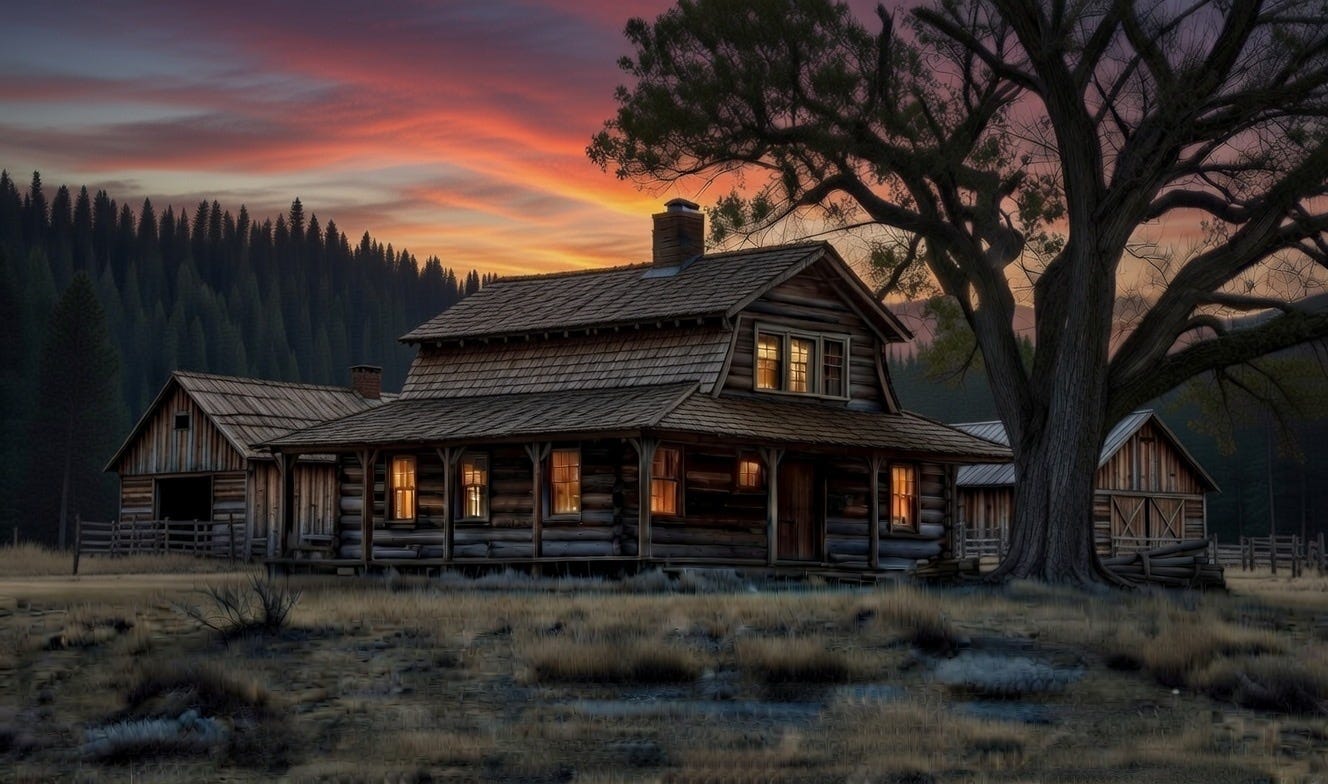
New chapters will publish roughly once a month as the story continues. If you want to follow Mason’s journey in real time, make sure you are subscribed.
Chapter Two: A Council in Crisis
Just before town, I saw a figure in the road between me and Cedar Hollow.
I reined Jasper in a little but kept him moving down the trail. The morning light was still thin, and I could not yet tell if the shape ahead was friend or trouble. As we drew closer, I slipped my thumb under the leather strap on my rifle and unbuckled the snap on my pistol, just in case. Out here, you never knew if a lone figure on the road was a raider scout or a neighbor you knew by name.
A few more yards and the shape sharpened. I let out a slow breath when I recognized him.
Joel.
He was a young man I had been helping for the last few months, giving him work when I could and trying to teach him some discipline. He was tall for his age, already looking a little like a man, but still not much older than Sierra. His parents had been gunned down outside Cedar Hollow a couple of years before, and he had been scraping by on his own ever since. Too young, when it happened, to keep the ranch running by himself. Old enough now to feel the weight of losing it.
The bank had taken the land not long after his parents died. Since then he had lived more or less in the cracks of our town... a week with one family, a stretch of days with another, nights at the little boarding house when he had coins in his pocket, working odd jobs, feeding stock, hauling water, doing whatever he could to stay one step ahead of hunger. He was not quite homeless, but he did not belong anywhere either.
As Jasper and I closed the distance, Joel shifted from one boot to the other and lifted a hand in a half-hearted wave, like he was not sure if he should be glad to see me or not.
“Mason!” Joel called, his face breaking into a grin.
I could not help but chuckle to myself. For all he had been through, the boy still carried a kind of childlike joy in him. There was a steady, stubborn hopefulness in Joel, almost a contagious optimism that things would work out. Not the lazy kind that waits for luck, but the kind that keeps working while trusting that God has not lost track of his path.
“Hey there, Joel,” I said, easing Jasper to a stop in front of him. “How is it going? What are you doing all the way out here?”
He shifted his weight and hooked a thumb back toward town. “I been hearing all the talk. Ever since Sheriff Rudd was gunned down, folks have been in a panic. Everyone is talking at once, no one listening. I slipped into the council chamber last night, up in the back, and I heard them say you were coming.”
He looked up at me, eyes bright. “Mason, I am telling you, people were worked up over everything until they heard your name. Then it was like the air changed. Not all at once, but... calmer. Well, except for you know who, grumbling in the corner. But most folks, I think they believe maybe things will not get completely out of control now.”
I sat there a moment, feeling the weight of that settle in. People were far too quick to pin their hope on one man.
“Joel,” I said, “if there is anything I have learned, it is this... chaos loves to eat. It will keep eating and eating until somebody stands in its way. That is what I am riding in for. To see if we can stop it before it swallows this town.”
He nodded slowly, as if he were tucking the words away for later.
A thin sorrel gelding horse was tied to a scrub oak by the side of the road, the reins looped low. Joel walked over, untied them, and swung himself into the saddle with more enthusiasm than grace.
We talked a few minutes more as we rode side by side, the roofs of Cedar Hollow drawing closer with each step. Then we turned our horses fully toward town, heading in to face the council and find out what, if anything, could be done.
We rode the rest of the way in and went straight to the council hall, a long, drafty building that served as church on Sundays, meeting place on weekdays, and storage for extra supplies all the time. We tied our horses to the rail out front and started up the steps.
Before we even reached the door, I could hear voices inside. Not full shouting, but sharp enough to know there was angst in the room.
“Yes, but what about...”
I could not make out the rest before another voice cut in.
“I told you, we cannot do that.”
I glanced over at Joel. He looked back at me, eyes wide and a little uncertain. I let out a quiet breath and half smiled. “All right,” I said. “Here we go. Ready or not.”
We stepped inside and the sound died almost at once.
The council hall was a long rectangle of a room, built from rough pine boards that had been whitewashed years ago and then stained again by smoke, dust, and time. Narrow windows with wavy glass let in a thin wash of morning light, cutting pale stripes across the plank floor. At one end stood a small raised platform with a plain wooden pulpit and a simple cross on the wall behind it, reminders that this was also our church. Along the side walls, sacks of flour and beans, coiled rope, spare tools, and a stack of old crates made it clear the room doubled as the town’s pantry and storeroom.
A potbelly stove squatted near the center, cold for now, with a ring of mismatched chairs pulled close from last night’s meeting. The air smelled like old wood, lamp oil, leather, and yet also the faint peace of last Sunday’s hymn-singing.
At the long table near the front sat most of the town’s council... men I had known for years. Reverend Mudd, still in his collar, though he was here more as a neighbor than a pastor. Wally Briggs, the gray-bearded farmer who had been arguing with me over one thing or another since the day I moved up on the hill. Tom Avery, who ran the general store and knew every family’s business by what they bought and what they stopped buying. Hank Lopez, the blacksmith, arms crossed over his barrel chest, face as serious as his anvil. Ezra Pike, who owned the livery and had an eye on every horse and wagon that came through town. And Mr. Carter from the bank, his vest neat, his expression tight, always counting costs even when he did not have a ledger in front of him.
A few other men, ranchers and tradesmen, lined the back wall on old pew benches. Joel slipped in among them, close enough to hear, smart enough to stay out of the way.
For a heartbeat, it felt like I had stepped outside my own body, watching myself from somewhere near the rafters. Moments like that can feel like they last for minutes, but they are really only the smallest fraction of a second.
In that sliver of time, two lines floated through my mind. Captain Harris again, clear as if he were standing beside me. Organize or get eaten. And then my own words to Joel on the road... chaos loves to eat.
Clearly it was time for someone to try to settle this room before the fear finished chewing through it.
So I did the one thing nobody expected.
“What are you all doing here?” I asked, straight-faced.
For a moment there was only silence. Wally rolled his eyes so hard I thought they might stick, but a few others chuckled, then a few more. The tension in the room eased just enough that breathing felt possible again. Folks knew in that instant what I knew... if we were going to work together, it was going to be a long road.
I walked farther in and found an empty chair near the end of the table. Someone had left a tin cup upside down on a sideboard. I picked it up, blew the dust out, and poured myself some coffee from my canteen.
“Hey, you got any more of that?” Reverend Mudd asked from his seat.
“Of course I do,” I said, and tipped some into his cup as well.
“Me too?” Joel asked from where he had slid in along the wall.
“Yes, absolutely,” I said, and poured him a share.
I took a sip, then set my cup down and looked around the table. “All right,” I said. “Tell me where we are. I do not want this to turn into pure chaos, with everyone talking over everyone else. We will go around the table one by one. I just want to hear your perspective.”
I nodded toward Reverend Mudd. “We will start with Reverend Mudd so he can give us an overview of what has happened and what the council decided last night. Then each of you can add anything you believe is important.”
Chairs creaked. Men shifted. A few eyes dropped to their hands. Little by little, the room began to move from noise toward something that might, if we were careful, become a plan.
Reverend Mudd cleared his throat and began. He went back over what he had already told me at the homestead... how Bill had been found on the road, how they had brought his body in, how word had spread through town like a grass fire in dry brush. He added details I had not heard yet, about the mood in the streets, mothers keeping children close, shopkeepers closing early, men who normally had plenty to say suddenly falling quiet.
“Since I rode back from your place,” he finished, “no one has seen any sign of the raiders. Nothing on the roads, nothing on the ridge trails. Some are saying maybe they have moved on.”
I let the words sit a moment. Raiding men do not kill a sheriff and then simply vanish forever. They might be gone for now, but men like that usually leave something behind... a mark, a message, or a plan to return.
One by one, the others around the table spoke. Their stories were not much different from what Reverend Mudd had described, but the tension in their voices told its own tale. They were frightened. They did not know what to do next. And under all of it was the same hard truth... Bill had been everything to this town, at least in their minds. Sheriff, mayor, and in many ways the spine that kept Cedar Hollow standing upright.
When the last man finished, the room fell quiet. I looked around at each face, taking a breath before I spoke.
“You all know my family and I came here for a simpler life,” I said. “You also know I have seen my share of trouble. I have dealt with chaos before. War, to be plain about it. But I want to be very clear about something.”
I let my eyes travel the table slowly.
“I am not a savior. And neither was Bill.”
A few men shifted in their seats at that.
“This town is not meant to stand on the shoulders of one man or even one family,” I went on. “Cedar Hollow is a web of families and friendships and neighbors. That is the strength we will need if we are going to face what is coming. So if I am going to step into this for a season, I want to be sure we understand how we are going to walk together.”
I rested my hands on the table.
“Confusion and hurt feelings are their own kind of chaos,” I said. “If we let that run wild in here, we will be too busy fighting one another to deal with the men who killed Bill. So I want to set a few simple expectations. If we can agree on these, then I believe we have a chance.”
I paused.
“First one is this,” I said. “We will speak our minds in here plain as daylight, and then we will stand together out there.”
I could feel Wally watching me, waiting for where I would go with it.
“I want honest talk in this room,” I said. “I want questions. I want you to tell me when you think I am wrong. What I do not want is a table full of men nodding yes while they are thinking no. That kind of agreeing to my face and arguing behind my back will tear this town apart faster than any raider ever could.”
I looked straight at Wally then, with the hint of a smile. “That means no murmuring in corners, no rolling your eyes every time my name is mentioned, no little side meetings to work against decisions that were already made.”
A couple of the men glanced at Wally and then quickly looked away.
“All of you have walked different roads to get here,” I said. “You carry different kinds of wisdom and scars. I want to hear those. I mean that. But once we have talked it through, somebody has to make a call. For now, that falls to me.”
I let that sit a moment, then looked slowly around the table.
I said, pausing on each word, letting my gaze land on each man in turn and finally stopping on Wally when I reached the last one. “Every... single... one... of... you,”
A few chairs creaked. No one spoke.
“When a decision is made,” I went on, “I need each of you to back it as if it were your own idea, even if you argued against it at first. If someone in town asks you about it, your answer needs to be, ‘Yes, this is what we are doing.’ Not ‘Well, I never agreed with it in the first place.’ We can disagree here. Once we walk out that door, we face this thing as a single line.”
I looked around the table again and let the silence stretch.
“That is the first condition,” I said quietly. “Do we agree on that much?”
Each of them nodded in agreement. No one spoke. The silence that settled over the table had weight to it. Even Wally gave a small, reluctant nod. For all his grumbling, he felt the moment too.
“Good,” I said quietly. “I respect each of you. I know we do not always agree or even get along, but you are my extended family. Of course Elle and the girls are my first concern after God. But God sets the solitary in families, and not just our own blood. He settled us here, on the hill above Cedar Hollow, for a purpose.”
I drew a breath.
“That leads to the second thing we need to agree on,” I said. “Bill’s widow and his children will be cared for better than if he were still here. They will not go hungry. They will not go without what they truly need. We will honor Bill by honoring his family. He bled for this town. While I am in this chair, and while we are here, his wife and children will not be left wanting.”
No one moved.
“Here is what I want us to do for them,” I went on while occasionally catching the eyes of our Banker Mr. Carter. “We will find out what debts they carry and we will see them paid. We will take stock of what they have and what they lack. We will think not just about today, but about those children’s future... work, schooling if they can get it, a chance to build something of their own someday. And we will treat them as if they were our own kin. Because as of now, they are.”
At that, I saw something shift in Wally’s face. The hard lines did not vanish, but they loosened. The man had been through more than most, and the years had baked him into something tough and brittle. But everyone in that room knew there was still a heart of gold buried somewhere under all that dust and bark.
He clenched his jaw, eyes glistening, and before anyone else could find their tongue, he said, “Amen.”
His voice cracked on the word and he covered it up with a forced cough.
I have never seen a whole table of men turn teary-eyed at the same time, but that was as close as I had come. Heads bowed, hands tightened around cups and hats. For a brief moment, all the pride and fussing and half-hidden resentments were pushed aside by something simpler.
Even Joel, standing near the wall, had that look in his eyes. He knew what it was to lose family and then lose everything they had built. You could see a kind of quiet indignation rise in him at the thought of it... and a fierce agreement that this was the way things ought to be. We look out for one another, or we are no town at all.
“Agreed?” I asked, looking around the table.
“Agreed.”
“Agreed.”
“Agreed.”
“Agreed.”
The replies came one after another, each of the six men finding his voice, Wally included.
“Good,” I said. “So far we have two things settled. Now we need to talk about how we move forward. There are a few more matters we cannot leave fuzzy.”
I held up a hand and counted them off with my fingers.
“Authority and limits.
Help and compensation.
Plan of action.
And one more... how long this is meant to last.”
I let my hand fall back to the table.
“We have already agreed that in this room we will speak plainly, even disagree, and that once a decision is made, we will stand together. We have agreed that Bill’s family will be cared for as our own. Now we need to be clear on what you are truly asking me to do, what help I will need, how we intend to face what is ahead, and that this is a season, not a throne.”
I looked from face to face.
“First,” I said, “I need to understand the scope. Are you asking me to take on everything Bill carried... sheriff, mayor, disputes, law, all of it... and on top of that track down these raiders and protect the town? Or is there some other shape to what you have in mind? I do not want to guess at a job this size. I want it spelled out, here and now.”
A few of them shifted in their seats again, but no one spoke yet.
“Second,” I continued, “whatever is decided about compensation, I want you men to settle the amount among yourselves. Once you do, I want it split. Sixty percent to me. Forty percent to Joel.”
That got their attention. Eyes turned toward the young man by the wall.
“You all know Joel,” I said. “We should have taken care of his family the way we will now take care of Bill’s. We did not. He lost his folks and then lost the land they had bled to build. He is a hard worker. He is learning, and I need help. I want to deputize him and put him to use helping us bring some order to this mess.”
I nodded toward Joel.
“He has been helping me up at the homestead. He is not only handy with his hands. He is sharp, he listens, and he can speak plain when he needs to. He is exactly the kind of help we will require if we are going to turn plans on this table into work on the ground.”
Joel shifted, clearly unsure what to do with all those eyes on him, but he did not look away.
“Last,” I said, “we need eyes and legs in the right places. We must set patrols. Not someday. Now. We will lay out a schedule so that stretches of road and key points around Cedar Hollow are watched. Joel can help us draw that up and keep it running, so I can keep my attention on the broader trouble.”
I took another sip of coffee and set the cup down carefully.
“Along with that,” I went on, “we need to decide what our posture will be if the raiders never show their faces here again, and what it will be if they do. Mark my words, I believe they will be back. Men like that rarely strike once and walk away. But I do not intend for this town to live with its life on pause, always staring at the horizon, waiting for the worst.”
I let my gaze move from man to man again.
“We will grieve Bill,” I said. “We will care for his family. We will organize ourselves. We will bring Joel in to help with the details. We will put sensible patrols in place, so if the raiders come again, they find a town that is ready. And then, after all that, we will live. We will enjoy our little town and let it grow.”
I thought of conversations I had shared with Bill on cold mornings and late evenings.
“Bill had hopes and dreams for Cedar Hollow,” I said softly. “He wanted this place to be like a city on a hill, a place people could ride to for refuge or for a bit of joy. Some would stay. Some would just come up from Placerville to get away for a while. But he wanted it to shine. I see no reason to bury that now.”
I straightened a little in my chair.
“So,” I said, “let us talk plainly. What exactly do you need from me, what help are you willing to give, and how far are you prepared to go to see Bill’s hopes for this town carried forward instead of buried beside him?”
Reverend Mudd drew in a breath as if to speak, but I lifted a hand.
“One moment, Reverend,” I said. “I would like to hear from Wally first.”
There was a reason for that. I had learned over the years that you do not always start with the man who agrees with you most. Everyone in the room already knows where he stands. If you have set the tone, sometimes it is better to hear first from the one who has been your sharpest critic. That way you learn the shape of any true dissent, and you offer that man a chance to show whether he is here to stir up trouble or to stand in unity.
Wally let out a rough chuckle. “Me?” he said. “Why me? You do not really want to hear from me.”
I looked straight at him. “Wally,” I said, “when I said I respected these men, I was not only talking to them. I meant you too, old man.”
He snorted. “Oh, hush,” he muttered, but there was the ghost of a smile at the corner of his mouth.
“I mean it,” I said. “I want to hear from you. What do you think?”
He fell quiet then, staring down at his hands. After a long pause he cleared his throat.
“Mason,” he said slowly, “we need you to lead it all.”
The room went still.
“Bill had a vision bigger than any of us,” Wally went on, voice gaining strength as he spoke. “He was only halfway through it. No raiders...” he almost spat the word... “are going to ride into our town and steal that away from us. No way. No how. Not going to happen. This is our town. These are our families. This is our legacy.”
He lifted his eyes to mine.
“So yes,” he said, “we need you to take the helm. You know I will still disagree with you from time to time,” he added, and a few men chuckled softly, “but I give you my word... this is your time to lead us in a new direction and steer us out of this chaos. For however long it takes to steady us and raise up whoever comes next.”
He nodded once, firm.
“I agree,” he finished. “We will settle the compensation. We will bring on Joel. We will organize patrols. And then we will listen to your plan and work through the details together.”
I let the words settle and then looked around the table one more time.
“Anybody else?” I asked.
Reverend Mudd just sat there for a moment with a small smile on his face, hands folded in front of him. Finally he shook his head. “Nothing else to add,” he said. “I think Wally said it all. Mason... will you lead us?”
There was a murmur of agreement around the table, stronger this time, more sure.
I held up a hand.
“I will,” I said, “but I need one thing spoken out loud so there is no confusion. This is an interim post. I am not running for anything. I will step into Bill’s place for a season... long enough to steady this town, stand up better structure, and help find or raise up the next man. While I wear the badge, you treat me as sheriff and mayor. When the danger has passed and when we have a clear successor, I will hang that badge back on the nail and go home to my hill.”
A few of them nodded quickly, as if this matched what was in their minds already. A few looked uneasy, like they knew how often “temporary” turns into “permanent” once a man proves he can do the job.
“I need to say it plainly,” I added. “I came here to build something for my family, not to sit in this chair forever. I will lead as long as is needed, not one day longer.”
Wally let out a slow breath. “Fair enough,” he said. “Interim or not, we need you now.”
Reverend Mudd nodded. “Then it is settled,” he said.
I turned toward the back of the room. “Joel?”
He straightened where he stood. “Here I am, Mason,” he said. “I will do anything you ask.”
“All right then,” I said. “Let us put something in motion. We will start patrols as soon as we can... tonight if possible. I want riders on the edges of town, on the outskirts, and I want some regular travel between here and Placerville, at least once a week, just to see how things look on the road.”
I looked each man in the eye again.
“But we will not throw lives away,” I said. “Things can be replaced. Buildings can be rebuilt. We all know a life cannot. Not a husband, not a spouse, not a child. So we will be watchful and wise. Joel and I will speak with Reverend Mudd this evening about men we can trust to take the first patrols. Once we have a pattern that makes sense, we will call a town hall meeting and lay it out for everyone.”
The weight of the moment pressed in on me as I rose from my chair. We exchanged handshakes and brief words, the kind of talk that fills the air when there is nothing left to decide for the moment except to do what has been agreed. I told Joel we would speak later in the afternoon, then stepped out onto the front porch of the hall.
The air outside was cool, the sky higher and clearer than when I had ridden in. Cedar Hollow looked much the same as it had that morning... the same storefronts, the same dusty street, the same thin line of smoke rising from chimneys. That strange calm was still there in my chest. Not excitement, exactly, but something near it.
Talk is cheap, I thought. Agreement comes easy in a warm room, even from men who usually pull the other way. The test would come when fear rose again and the first hard choices met us in the road.
My eyes drifted down the main street until they found Bill’s house in the distance. The sight of it caught me harder than I expected. Sometimes we are so busy building our own legacy that we forget to look sideways and see how we might help carry the weight of a friend’s. It is not always selfishness. Sometimes chaos just detours our attention until nothing is left for anything else.
I looked at that little house and said quietly, “All right, old friend. Our legacies are tied together now.”
Just then Reverend Mudd stepped out beside me. He laid a heavy hand on my shoulder. “Well,” he said, “I thought that went real well, Mason.”
“It did,” I said. “But remember... when things get strained, that is when the ranks start to break. We need to move quick. Let us get patrols started, then call that town meeting as soon as we can. Those raiders are not likely to stay away forever. They will come back to see if we are still soft enough to pick clean.”
He nodded. “I agree.”
We stood there a moment in shared silence, looking out over the town we both loved.
As I watched the street and the houses and the people moving in the distance, I felt a knot tighten low in my stomach. I wondered what this would end up costing me. How long this “interim” season would really last. Whether the town would let me lay the badge down when the time came, or if the word “temporary” would quietly slip out of people’s memory once they grew used to leaning on me like they did Bill.
What would it mean for Elle and the girls if this stretched from weeks into months, from months into a year or more. Would the price be measured only in time and tiredness, or in something far deeper.
The questions did not have answers yet. They just settled there, heavy and unmoving, as Cedar Hollow went about its business and the day wore slowly on.
I glanced back down the dusty road toward Bill’s house and knew what had to come next. It was time to pay a visit to his widow, Annabeth.
Coming soon: Watching from the Hill, Chapter Three: Debts and Tracks
Make sure you’re subscribed so you do not miss the next chapter from Cedar Hollow.
If you want early access to future chapters and some behind-the-scenes notes on the writing and leadership themes in this story, consider becoming a paid subscriber. I will be building Cedar Hollow in public and would love to have you along for the ride.