


Author’s note: This is Chapter Three of my new novel, Watching from the Hill. It is a frontier story set in California’s gold country, about a quiet homesteader who gets drafted into leading his town after turmoil unfolds. I am writing it in public here on Substack so you can follow the story as it unfolds.
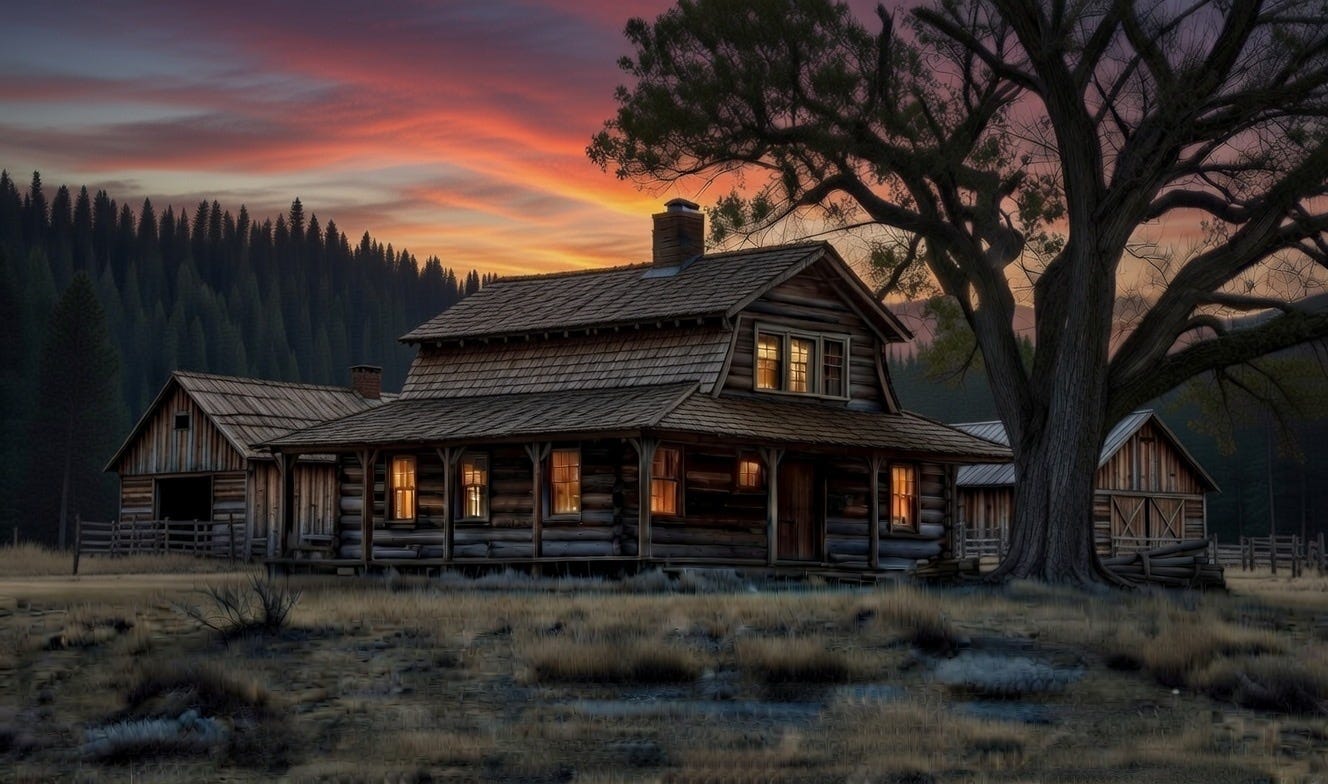
New chapters publish monthly as the story continues. If you want to follow Mason’s journey in real time, make sure you are subscribed to get early access.
“Sergeant, come quick!”
The shout came from behind me. I spun around and saw two of my men stumbling through the mud, boots slipping, carrying another man between them. His uniform was soaked dark with blood.
I ran to meet them and got my shoulder under his arm to help take the weight. As I looked up at his face, my stomach dropped. It was my second in command, Bill Rudd.
“What happened?” I snapped, as we half dragged, half carried him toward the infirmary tent.
“Sorry, Mason,” Bill groaned, head hanging, breath shallow.
We pushed through the canvas flap and the smell of medical alcohol, sweat, and old blood filled the room. The doctor was already moving, clearing a rough wooden table with the back of his arm. Together we got Bill laid out flat.
The Doc grabbed a knife, cut the shirt away from Bill’s chest, and peeled the fabric back. A knife wound glared up at us from just below his shoulder… deep, ugly, pulsing bright red and then oozing dark.
“Hold him,” the Doc said. He pressed a wad of cloth hard against the wound and leaned in close. After a moment he grunted. “You’re lucky. Looks like it just missed what would have finished you.”
Bill winced and turned his head toward me, eyes cloudy but still focused.
“You were right,” he whispered. “There are spies in camp. Caught one near the supply wagons.”
Around us the tent kept churning… men breathing, someone calling for water, metal clinking in a basin. All I could see was Bill, bleeding because I had trusted my gut and sent him to check the shadows around our food and powder.
“I’ve got you,” I said quietly. “We’ll take care of it.”
The Doc pushed me back a step so he could work. I stood there, fists clenched at my sides, already thinking through who I would question, where the weak places were in our lines, how I would close every gap that had let an enemy slip in among my men.
A wagon rattled somewhere close and the sound shifted. Canvas and lamplight faded. The smell of alcohol and blood thinned into dust and cold air.
I blinked and suddenly, I was back on the front porch of the council hall, boots on rough boards, looking down the main road of Cedar Hollow toward Bill’s house. My jaw was tight, my hands still half clenched from the vivid memory of my dearest friend.
Bill had trusted my judgment in the war. Now he was gone because this town had trusted him with theirs.
I drew a slow breath.
“All right, old friend,” I said under my breath. “First things first.”
I stepped off the porch, slow at first, then more determined, and headed down the road toward Annabeth Rudd’s house.
On the short walk I caught a few eyes here and there. People nodded or gestured toward me, then looked away. It was clear there was still a deep sense of fear in town, and also curiosity of what would come next.
I knew I would soon have to gather the whole town together to settle nerves, but even more importantly, to become united again in our resolve to overcome this chaos and fear.
As I approached the Rudd’s home, a hefty weight settled on my heart. I knew there was nothing I could say to Bill’s widow that would ease the deep pain of losing not only her husband and provider, but her closest friend in the world.
Their relationship reminded me a lot of mine and Elle’s… founded on more than fleeting emotion and young love, built on a foundation of friendship and, even more importantly, their love and dedication to God.
They had walked through so much over the years. Good and bad, happy and sad, but one thing always remained constant… they would tackle it all together. Now she would have to find a new way forward and sadly tackle a lot of it on her own.
I stepped up onto the porch, took off my battered cowboy hat with my left hand, and knocked on the front door with my right.
The door swung open, and to my surprise and relief it was my wife, Elle. Her eyes were red, but there was a softness there when she saw me.
“What are y’all doing here?” I asked gently.
Elle gave a tired little smile. “The girls and I wanted to come sit with Annabeth,” she said. “Didn’t feel right leaving her alone.”
Over her shoulder I could see into the main room. Sierra and Natalie were on the floor with the Rudd children, who were much younger, stacking worn blocks and trying to coax a giggle out of them. Our girls caught my eye for just a brief moment and gave me a small, knowing smile. They understood I was there to talk with Annabeth, and that the best way they could help was to keep the little ones busy while we did.
The room was small but familiar… a wood-burning stove glowing in the corner, a simple table with four mismatched chairs, Bill’s worn coat still hanging on the peg by the door.
Annabeth looked up from where she’d been sitting and caught my eye. She stood quickly and hurried toward me.
“Oh, Mason!” she cried as she reached the doorway. She threw her arms around me and began to weep into my shoulder. “How is this God’s plan?”
I held her tight, letting her shake and sob for a moment, giving her space to feel the full weight of it. “I am so sorry, Annabeth,” I said quietly. She only squeezed tighter. Elle stepped up beside her and rested a hand on her back, stroking her shoulder in slow circles.
After a while, Annabeth drew in a long breath, pulled back, and wiped at her eyes with the heel of her hand. She cleared her throat, and there was a hint of that familiar stubbornness under the grief.
“I may not know the plan,” she said, voice still trembling, “but I am sure glad you and Elle and the girls are here right now. Come on in, Mason.”
I stepped inside a room I had been in dozens, if not hundreds, of times… cups of coffee at that table, long talks with Bill about land and weather and this little town of ours, babies passed around the room when each of their children were born.
I moved over near the stove and took a seat at the dining table. Elle sat beside Annabeth on the small settee, the two women close enough that their shoulders touched. The children kept playing quietly on the floor, as if even they knew something sacred was happening in the room.
“Annabeth,” I began, folding my hands together on the table, “I talked with the town council last night. They wanted me to come and speak with you in person.”
She looked up, eyes tired but steady. “I heard some of it,” she said. “Folks talk. They say the men down there have asked you to step in. Sheriff. Mayor. All of it.”
I nodded. “They have asked me to serve for a season,” I said. “Interim. Long enough to steady things and help us find the right man to carry it after. I only agreed on a few conditions. One of those is you and the children.”
She swallowed hard. “Mason, nothing replaces Bill,” she said softly. “Not another leader. Not plans. Not money. You know that.”
“I do,” I said. “This does not replace him. It is simply what we can do on our side of the loss.”
She looked down at her hands, then back at me. “What did they decide?” she asked.
I took a breath. “First,” I said, “we agreed that this town will take care of you and the children. Better than if Bill were still here… that was my exact wording.”
Her eyes filled again, but she did not look away.
“The men at that table agreed to find out what debts you and Bill had,” I continued, “and see them paid. We will take stock of what you have on the property and what you lack. We will make sure you and the children do not go hungry and do not go without what you truly need.”
I glanced toward her kids on the floor. “We also talked about their future,” I said. “Work when they are old enough. Maybe schooling, if we can get it. Opportunities so they are not stuck in the shadow of this moment for the rest of their lives.”
She covered her mouth with one hand, and tears slipped down her cheeks again, quieter this time.
“And I told them,” I added, “that as of now, you and the children are to be treated as our own kin. Not charity. Family. That is what we agreed.”
For a long moment she did not speak. Elle reached over and took her hand.
“Do you believe them?” Annabeth asked finally, her voice barely above a whisper. “Men say a lot of fine things in meetings when the hurt is fresh.”
I nodded slowly. “I know,” I said. “Talk is cheap when the room is warm and no one is out in the dust yet. But I looked each of them in the eye. Wally, Tom, Hank, all of them. They agreed. And I told them as long as I am wearing that badge, I will hold them to their word.”
I leaned forward a little. “It will not bring Bill back. It will not erase what happened on that road. But you will not walk this alone.”
She stared at me a moment, searching my face like she was testing each word for cracks. Then she let out a long, shaky breath.
“You know Bill trusted you,” she said. “Even when he did not agree with you, he trusted you.”
“I know,” I said quietly. “I trusted him too.”
She nodded, more to herself than to me. “All right,” she said. “If you say the town has agreed, I will believe you. And if they forget…” there was a tiny spark of fire in her eyes now, “I will come down there and remind them.”
A small smile tugged at the corner of my mouth. “I do not doubt that one bit,” I said.
The room fell into a softer quiet. The stove crackled. One of the children laughed at something Sierra did with the blocks. For the first time since I had stepped onto the porch, the weight in the room felt a little more shared.
“We will come by again,” Elle said gently. “Not just today. Often. You are not going to be rid of us that easily.”
“Good,” Annabeth said, squeezing her hand. “I do not want to be.”
I sat there a moment longer, looking at Bill’s coat on the peg, his boots by the door, his children on the floor, and his widow between my wife and the stove, held up by hands that loved her.
Nothing we decided in that council room could ever balance those scales. But this was where it started… with a promise to take care of our own, and the quiet decision to keep that promise when the grief was no longer fresh and the town had moved on to the next thing.
In my mind I heard Captain Harris again. Organize or get eaten.
I looked back at Annabeth. “We will be back soon,” I said. “And in the next day or two, we will be calling a town gathering. When that happens, if you feel up to it, I would like you there. People need to see what we are fighting for.”
She nodded slowly. “If I can stand, I will be there,” she said.
I rose from my chair and picked up my hat from the table. “All right then,” I said. “One step at a time.”
I said my goodbyes to the children, gave Annabeth’s hand a gentle squeeze, and stepped back out onto the porch, the cold air washing over me as the door closed softly behind.
The town still looked the same as it had that morning. But after that visit, I knew for certain… whatever came next with the raiders or the council or my own family, turning away was no longer an option.
As I walked back toward the town hall, the wind started to pick up. I looked past the buildings to the mountain range in the distance and saw dark storm clouds moving in our direction. Before long, the town would be drenched in rain.
And I knew this was not the only storm we would have to face in the weeks and months ahead.