

Empires fail the same way marriages fail, the same way teams fail, and the same way leaders fail.
Slowly… then suddenly.
One day it looks like everything is fine. The next day there is a headline, a resignation, a split, a collapse that “no one saw coming.”
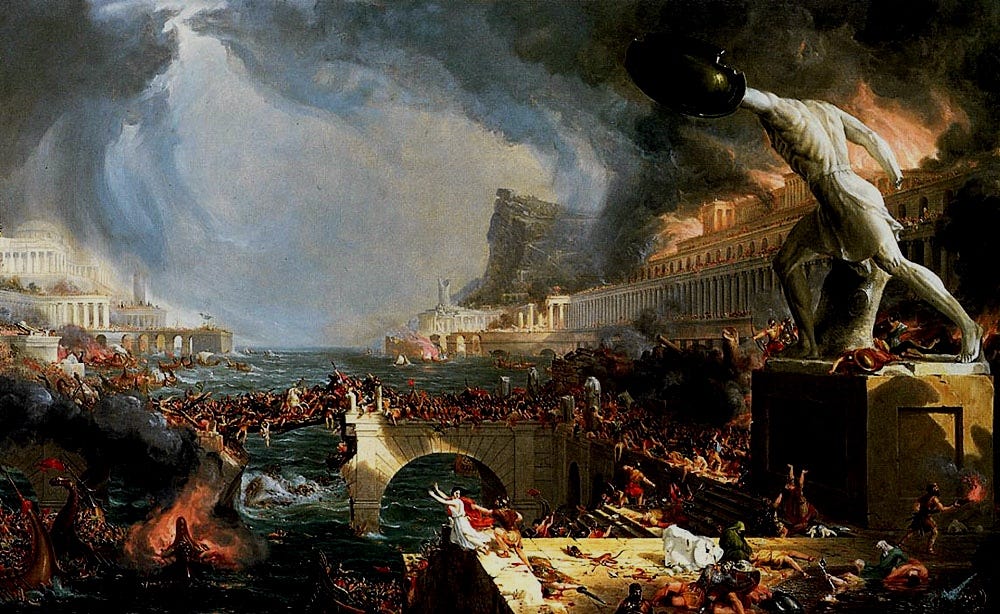
But if you rewind the tape, the warning signs were there.
I have seen it in a startup that went from on fire (in a good way) to acquired in a fire sale in under a year.
I have seen it in a church that went from vibrant to fractured while the services still looked vibrant on Sunday.
I have seen it in leaders who looked successful on the outside while everything that actually mattered was quietly decaying.
This is not just a story about them. This is a letter to you.
Here is my simple thesis: If we ignore the quiet patterns that topple empires in history, those same patterns will slowly… then suddenly… collapse our teams, our families, our churches, and our own leadership.
Because the same forces that pull empires apart also pull families apart, teams apart, churches apart, and companies apart.
Those forces do not show up with trumpets or headlines. They sneak in as patterns… small shifts in how we lead, how we spend, how we treat people, how we view the story of our success.
In this letter, I want to trace that pattern in three layers. First up close in one company. Then zoomed out across history. Then right back into the kind of leadership you and I live every day.
NOTE: We have all toppled statues and burned buildings along the way, so as we dive in let’s read with grace, love, forgiveness, and a quiet optimism of redemption… not with shame that only continues the collapse of our own empire.
1. The Pirate Ship: Complacency in success
The first place complacency hides is in our success.
Early in my career I worked for a dot com that was absolutely on fire… in a good way.
Two brothers ran the company. They were smart, scrappy, relentless. We were one of the fastest rising companies in our space, making money hand over fist. There was that electric feeling in the air that only happens when you are building something that actually works.
Then the shift happened. Slowly the story moved from building to flexing.
First it was impressive catered events. Then bigger parties. Then the big one…
A company wide “training” week in Cancun.
A couple hundred people. Required attendance. No spouses. No significant others. A full week of all inclusive resort life, catered meals, and sessions that were called “training” but felt mostly like an excuse to party in paradise.
One evening, after a steak dinner, a huge party, and a Hollywood style mock sea battle between our two pirate ships… yes, it was epic… I was sitting alone in my room looking out at the ocean and I had this sinking feeling (pun intended) that those ships were a metaphor for what was coming.

The “training” was shallow. The return was minimal. The cost was enormous.
Less than a year later, the company folded through an acquisition. No one other than the founders got rich.
We did not get taken out by a competitor. We got taken out by our own pride, entitlement, and desire for the easy life.
That pirate ship week was not just a bad leadership call. It was one turn in a larger pattern and Complacency in success just poured fuel on the fire to accelerate towards collapse. I have come to call the pattern… The Complacency Trap:
Hunger → Comfort → Complacency → Entitlement → Drift → Fragility → Collapse
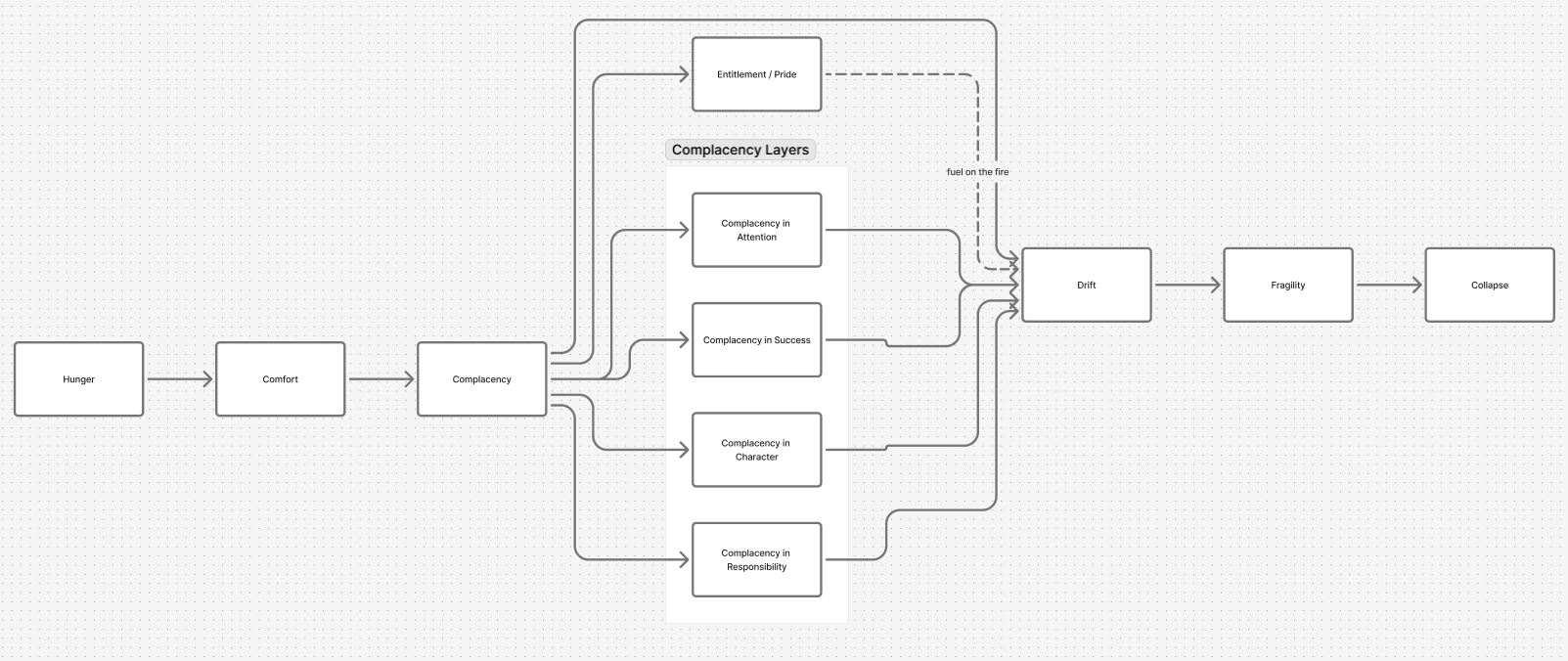
If you zoom out from one small company to the sweep of history… you see the same pattern written in stone tablets and rolled up scrolls over and over again.
In the next two sections we will zoom out a bit before we zoom back in to break down the various ingredients of the complacency trap.
2. History Is Just A Larger Version Of Us: Complacency at scale
If that pirate ship moment was one snapshot, history is the wide angle lens. The same pattern that sinks companies shows up in the rise and fall of empires.
All civilizations rise. All civilizations fall.
Rome did. Athens did. The Ottomans did. The British Empire did. Blockbuster did.
The Western Roman Empire is conventionally said to have ended in 476 AD, when a teenage emperor, Romulus Augustulus, was forced to abdicate and a Germanic general named Odoacer took his place as ruler of Italy.
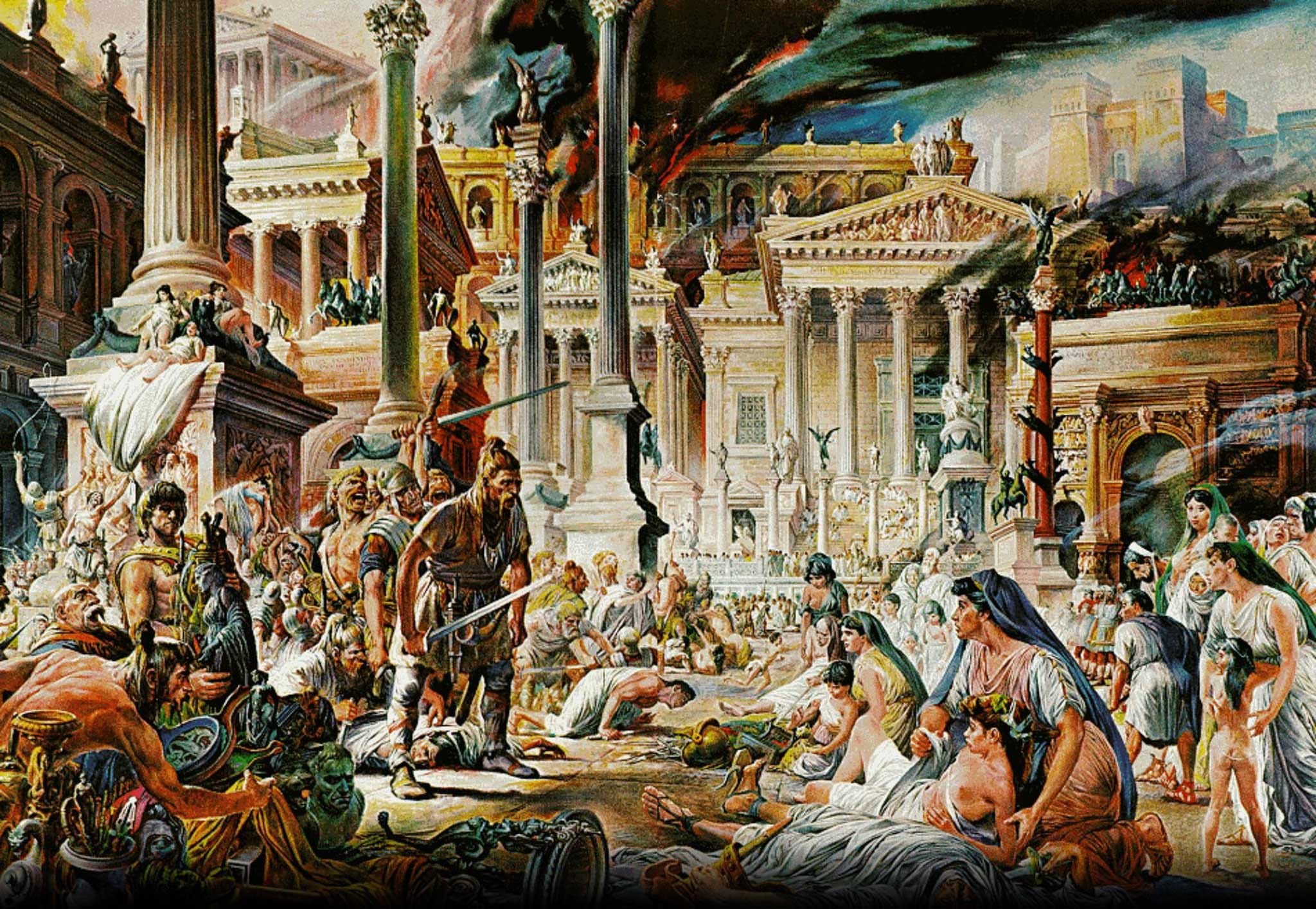
Athens went from its Golden Age under Pericles in the 5th century BC to defeat in the Peloponnesian War by 404 BC.
The Ottoman Empire, once a global power, had its sultanate abolished in 1922. The Republic of Turkey was proclaimed the next year, in 1923.
By 1913 the British Empire ruled hundreds of millions of people and close to a quarter of the earth’s land surface. Today it exists mostly in history books and a loose web of commonwealth ties.
Every empire believed it was the exception. Every generation does.
Strip away the marble and the maps and you see familiar patterns:
Hunger becomes comfort
Comfort becomes complacency
Complacency becomes entitlement
Entitlement becomes decay and drift
The timeline is larger, but the story is the same as that dot com partying in Cancun on pirate ships.
And the same as what happens in homes, teams, churches, and companies every day.
History proves the pattern at scale. Now let’s talk about what it looks like inside the character of leaders and communities long before the headlines get written.
3. Moral Drift Comes Before Collapse: Complacency in character
If complacency in success is about how we handle the wins, complacency in character is about who we silently become while no one is watching.
Historians love to talk about wars, interest rates, and debt ratios. But if you look closely at history, moral drift almost always shows up before the economic crash or the political fracture.
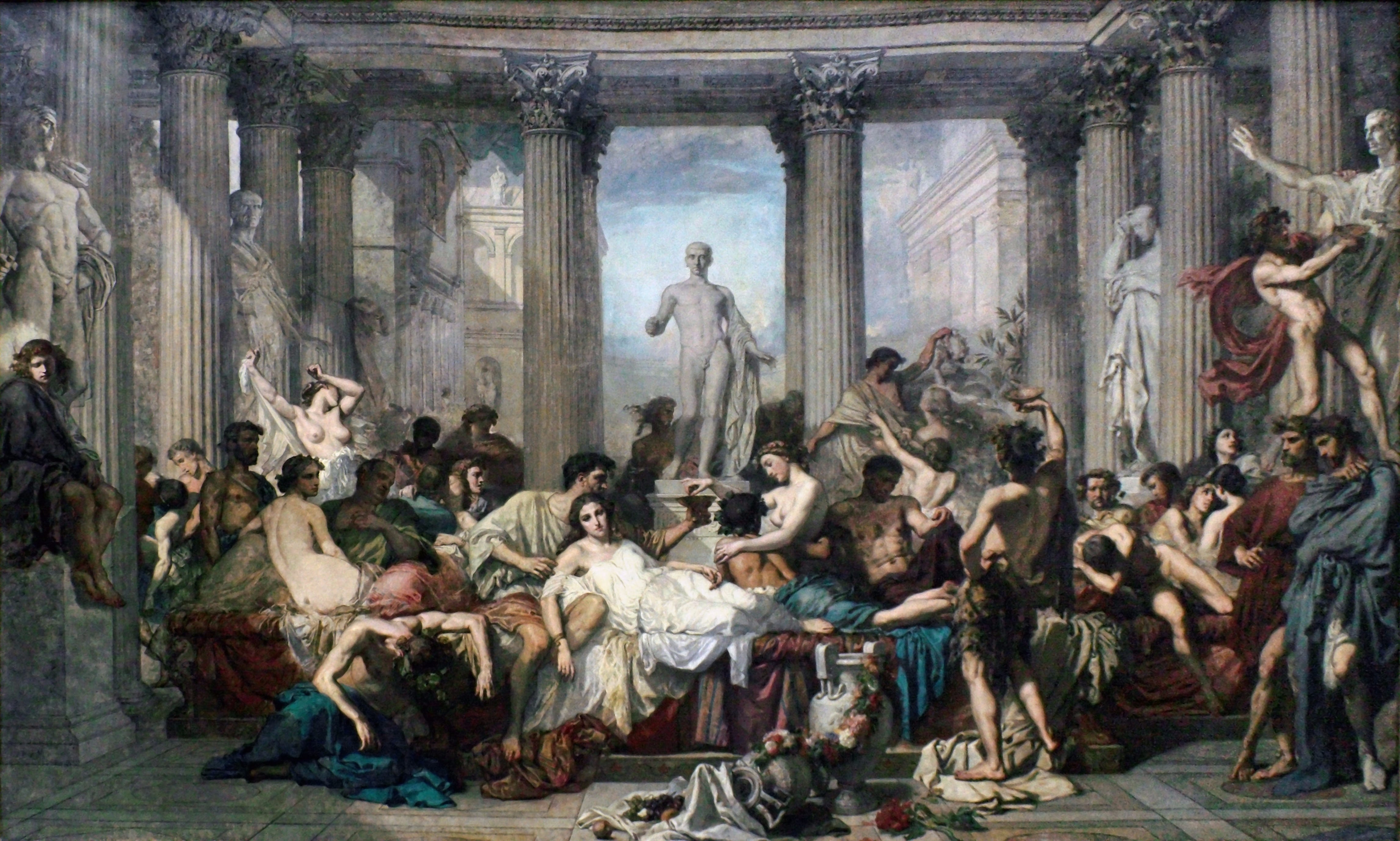
In ancient Rome, the satirist Juvenal wrote about “bread and circuses”… a population pacified by free grain and entertainment instead of citizens engaged in the hard work of a healthy republic. He saw what was happening long before the last emperor fell.
I have seen a softer, more personal version of that inside a faith community.
For a season, the church we were part of was thriving. The building itself was nothing impressive. No massive screens, no lasers, no smoke machines.
But the people were incredible. The worship was authentic. The community was thriving.
If someone had a baby, meals appeared at their door. If someone was sick, they were not alone. People served, gave of their time, and actually knew each other’s names.
The connective tissue was healthy. Then slowly the tone at the top began to change.
Inside the leadership team, conflict started to show up… not as honest disagreement, but as tearing down. The leader’s style shifted from pastoral to intense and critical. People were not being developed, they were being critiqued and pitted against one another.
It became more about the leader and platform than the people. More about optics than obedience.
From the outside, things still looked fine. On the inside, trust was rotting.
Over time, that leader lost the confidence of the team and the community. Eventually they moved on, and what had been growing and vibrant was suddenly fractured, fragile, and broken.
Moral drift rarely announces itself with a press release.
It shows up in:
How we treat people when they have nothing to offer us
Whether we use “calling” as cover for control
Whether we quietly tolerate behavior in high performers that violates what we believe
You can see the same thing at scale.
Confidence in major institutions has been sliding toward historic lows. Surveys over the last few decades show trust in government, media, and large organizations dropping from roughly one in two people expressing confidence to closer to one in four or five.
Among younger adults, the numbers are even more stark. In recent national polling, fewer than one in five young Americans say they trust the federal government to do the right thing most of the time, with similarly low numbers for Congress and other institutions.
That is not just “politics as usual.” That is the sound of a generation quietly stepping back from the institutions that were supposed to steward their future.
Here is the connection for us as leaders:
When leaders abandon discipline, humility, and integrity… people eventually abandon trust.
That is true in Rome. It is true in a church. It is true on your team. It is true in your home.
4. When You Outsource What You Should Build: Complacency in responsibility
Complacency in character usually shows up in what we tolerate. Complacency in responsibility shows up in what we hand off too quickly.
I do not talk about this much, but I am a failed church planter.
My wife and I had served as associate pastors for years. Eventually we were invited to plant a new church in the city where we lived. The idea was simple… start a new community that would reach people in that city in a fresh way.
So we did what we do… we started with hospitality.
We opened our home. We had large parties, small gatherings, and even public espresso events. We started gathering people. We built a core team.

Over time that group grew to around thirty people if you counted kids. We were doing a monthly Bible study in our house and building relationships.
Then the pressure started. The leadership team really wanted us to start a weekly service.
“If we launch a Sunday service, people will come.”
Instead of arguing, I asked them to do an exercise.
“Write down every person you know in our city,” I said. “Everyone. Your barista. The person at the gym. Neighbors. Coworkers. Parents from your kid’s school. The only catch… those who actually know your name or face.”
They filled out their lists.
Then I said, “Now I want you to highlight everyone on this list who is not already connected to another church. They might know Jesus or not. They might be burned out on church or never have gone. Just highlight anyone who is not already plugged into a faith community.”
When they finished, most of the pages were almost completely unmarked. Almost everyone they knew was already going somewhere else.
That moment was a clarifying punch in the gut that I knew was coming.
If we launched a weekly service right then, we would probably get a hundred or two hundred people to show up. On paper it would look like “momentum.”
But almost all of it would be transfer. Growth by subtraction from other faith communities in the city… many from churches where I knew the pastors… I was not going to be any part of that.
We were not yet woven into the fabric of the city. We had not done the slow work of knowing entrepreneurs, baristas, neighbors, families.
We wanted the outcome of influence without the investment of relationship.
I told the team we were not ready. We needed more time in coffee shops and living rooms, more conversations with people far from church culture, more real connection.
That conviction became a point of contention.
Eventually it became clear that the plant was no longer viable. We shut it down and went another direction serving a young pastoral couple who took over a local congregation and asked if we would walk alongside them.
On paper, that is failure. In reality, it has become one of the most important leadership lessons I have ever learned.
You cannot outsource or import the things you are called to build. Real value, real impact, real empires of the soul are built the hard way.
Blood. Sweat. Tears. Consistency. Time.
5. Bread, Circuses, And The Age Of Infinite Distraction: Complacency in attention
And then there is our attention… the quiet place where empires, families, and teams either deepen or drift.
Like we talked about above, Rome placated its citizens with bread and circuses. Free grain and public games. Juvenal used the phrase to describe a people who had traded their influence for entertainment.

Today we have something far more efficient. We carry circuses in our pockets.
Infinite content. Infinite outrage. Infinite noise.
On the surface we feel informed. In reality, many of us are numb.
The danger for us as leaders is not just that our people are distracted.
It is that we are.
We numb out instead of reflecting. We check our phones instead of checking in on the person sitting across the table. We chase shallow visibility instead of slow credibility.
An empire addicted to distraction cannot endure deep crisis.
Neither can a family. Neither can a team. Neither can a soul.
6. The Kingdom That Does Not Fall: The antidote to fragile empires
If history only told a story of decline, we could just throw our hands up and wait for the credits to roll.
But thankfully, that is not the whole story.
Athens did eventually restore its democracy after the nightmare of the Thirty Tyrants. The ashes of failed empires often become the soil for new nations and new beginnings.
And as a follower of Jesus, I hold on to an even deeper reality. Scripture says we are “receiving a kingdom that cannot be shaken” (Hebrews 12:28).
Empires rise and fall. Markets boom and crash. Institutions gain and lose credibility.
The kingdom of God does not.
That does not mean our organizations are guaranteed to survive. It does mean our work is not just about propping up a system.
It is about aligning our leadership with something that outlasts this era.
When you lead with integrity… when you repent instead of justify… when you serve instead of use people…
You are not just being “a good manager.” You are bearing the image of a King whose rule is not fragile.
That is why this matters so much.
This is not just about saving a company or a brand. It is about stewarding people and moments that God cares deeply about.
7. Your Empire Is Closer Than You Think: Stewardship where you stand
You may never sit in a palace or Parliament. But you are an emperor or empress of something.
Your “empire” might be:
A family that gathers around your kitchen table
A classroom full of kids who will remember your face forever
A team of three inside a giant org
A small business trying to create good jobs in your town
A congregation, a nonprofit, a community group
The same forces that topple empires show up in those spaces too.
Complacency when you stop coaching and just “let things ride”
Moral drift when you choose comfort over truth in a hard conversation
Outsourcing when you expect someone else to build the relationships you are called to build
Distraction when you offer your people presence but not your mind and heart
Division when you let resentment grow instead of stepping into reconciliation
The good news is that the same pattern of renewal can begin there too.
You correct the course of history by correcting the course of your little corner of it.
A Letter To You, Leader
So here is my plea.
From a former homeless addict who now sits in rooms with executives. From a failed church planter who still believes in the Church. From a director in tech who has watched both startups and systems rise and fall. From a Husband and Dad that has failed more times than I can count… but love my bride and children more than words can express.
Raise the standard.
In your company. In your church. In your team. In your family. In yourself.
Do not wait for a national revival, a corporate reorg, or a new election cycle. Be aware of The Complacency Trap and root it out by being purposeful in your interactions after you read this… the next one on one where you could play it safe or ask the real question… the next conversation at home where you could hide in a phone or actually engage… the next ethical decision where you could nudge the number or take the hit.
Before you click away, take a breath and ask yourself three questions:
Where have I grown complacent, and what is one concrete step I can take this week to re engage as a leader?
Where have my values drifted from what I say I believe, and what is one act of integrity I can take to realign?
What am I outsourcing right now that I am actually called to build?
If you are willing, share one honest answer with your people… or in the comments… or a private DM to me. That small act of honesty might be your first rebellion against decline… and the first brick in the legacy you are meant to leave.
You may not be able to fix everything that is broken around you. But you can be faithful with what has been put in your hands to lead. That is how we avoid the complacency trap… Step by step, principle by principle… one brick at a time.
And if you want to keep building this kind of honest, faith friendly leadership community, consider subscribing to Leader Unlock… and when you are ready, upgrading to paid so we can go even deeper together.
I have lost a lot of trust and belief in myself about things getting done (my wife has also lost a lot of trust in me in this area, too). There's been no shortage of significant and overlapping challenges in doing so, but things need to get done all the same... things need to progress.
One concrete step I will take this week is to begin to add due dates to tasks and commit to completing them by that deadline.
This is one of the most unnerving and fear-inducing things for me to consider doing, right now. which probably means A.) That it is important to tackle, and B.) That it will provide a substantial return on investment.